The Essence of Vedic Marriage
Back in the day, our ancestors recognised and acknowledged the most basic instinct of all – the need for companionship. That’s when they came up with the idea of marriage, a sort of ultimate partnership. Life is a rollercoaster of conflicting emotions, endless dilemmas and a ton of highs and lows, but imagine having someone to share it all with. That’s like having a co-pilot for the crazy ride of life.
Yudhishthira, the oldest of the Pandava brothers, once faced a tricky question from a mystical forest spirit:
kimsvid daivakrtaha sakha
bharya daivakrtaha sakha
— Mahābhārata — Yakṣa Praśna
Who is a man’s god-given friend?
A man’s god-given friend is his wife.
Yudhishthira’s reply totally nails what marriage is all about—it’s like the original definition of #RelationshipGoals. His answer shines a light on the deep friendship between partners, showing how Vedic marriage isn’t just about romance, but about being there for each other through thick and thin.
What does “Vedic” really mean? Well, it’s not just some old-school term from way back. The Vedas, those ancient scriptures, are basically the original source code for life. They contain within them the knowledge on everything from relationships to spirituality. So, when it comes to understanding concepts like marriage in the present world, we might find some surprisingly relevant insights in these ancient texts. It’s like unlocking the secrets of the past to navigate the present.
The Origin of Vedic Marriage
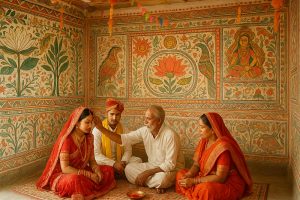
Now, let’s time-travel back to the Vedic era to understand the origins of Vedic marriage. In the Rigveda, one of the four Vedas, there’s an enchanting anecdote of how the institution of marriage came to be. It tells the tale of Soma, a god eager to unite in matrimony. Soma sends forth two divine messengers, the Aswini devatas, to seek the hand of Surya, a maiden, from her father, Savita. Upon Savita’s gracious acceptance, in the presence of the god of fire as witness, Soma and Surya are joined in holy matrimony. This ancient tale has been passed down for centuries, shaping how we see marriage and the rituals that go with it.
What Exactly is Vedic Marriage?
So, what exactly is Vedic marriage? Why dig into age-old Vedic wisdom when we can easily find influencer ‘Gurus’ with just one swipe? Let’s dive in and explore the essence of this sacred union.
Vedic marriage isn’t your typical swipe-right, sign-on-the-dotted-line kind of deal. It’s a holistic union deeply rooted in ancient Indian traditions and spiritual beliefs. Unlike modern marriages that often focus solely on legal and social contracts, Vedic marriage goes beyond the surface level. It’s a profound commitment between two individuals who embark on a shared journey of spiritual growth and self-realization.
According to the Vedas, human beings go through 4 stages of life beginning with education (brahmacharya), graduating to the status of a householder (grihastha), followed by retirement (vanaprastha), and eventually renunciation (sanyasa). The householder stage is when the individual is fully equipped, both physically and mentally, to perform his duties to himself, his family, his community, his country, and even to the world. Therefore, this stage is considered the most important. As an individual navigates through these stages of life, he undergoes different rites of passage meant for purifying one’s consciousness, called samskaras.
The Vedic scriptures identify 16 major sanskaras, known as the “shodasha sanskaras.” Every samskara is marked with a ceremony filled with rituals and traditions that bring families together for a greater cause. Vivaha Samskara is one of them.
Vivaha Samskara: The Vedic Wedding Ceremony
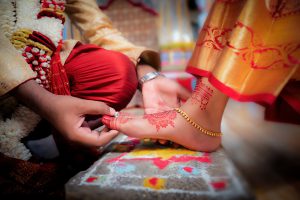
Vivaha Samskara refers to a Vedic wedding ceremony. It is one of the most important rites of passage in Sanatana Dharma. According to the Vaishnava saint Gopal Bhatta Goswami, “Vivaha” means “to maintain and uplift” and samskara means “perfect deed.” Thus, the Vivaha Samskara is the perfect deed that helps to uplift and maintain the couple in marriage, which is itself the way to enable the husband and wife to live peacefully and to purify themselves and their family.
Vedic weddings have a deep spiritual meaning. It is not just a colorful event but an interplay of rituals, a beautiful sacrosanct of traditions, familial bonds, and vows that extend beyond one’s lifetime. These days, couples often shy away from tradition and ceremony, dismissing them as outdated, superstitious, and a squandering of resources. But these age-old practices hold the key to something deeper, something that adds meaning to our lives.
Vedic Marriage: A Timeless Approach to Partnership
While Vedic marriage may seem like a relic of the past, its principles are surprisingly relevant even in today’s fast-paced world. In a world where relationships can be as fleeting as a Snapchat streak, Vedic Marriage is like a steady anchor in a sea of swipes. It offers a refreshing perspective on marital fulfillment founded on respect, equality, and spiritual harmony.
Let’s take a page from the Vedas and redefine what true partnership looks like. Are you ready to embark on this journey towards deeper, more fulfilling relationships?
Want a marriage rooted in this tradition? VedicMarriage.com offers Vedic vivah matchmaking — kundli (Ashtakoot) matching, Gotra/Nakshatra awareness, and family-guided introductions — alongside spiritual compatibility.